Navigating IEP's, 504's and Medical Neglect- A Legal Framework For Kinship Care
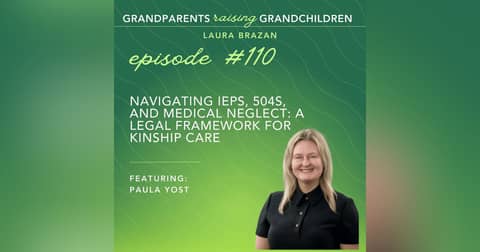



Are you a grandparent or kinship caregiver navigating the maze of IEPs, 504 plans, and medical decisions while advocating for a child impacted by trauma and neglect? Do you feel overwhelmed by failing systems, mislabeled as a troublemaker simply for demanding the support your grandchild needs to heal? You’re not alone.
I’m Laura Brazan, host of 'Grandparents Raising Grandchildren: Nurturing Through Adversity.' In this powerful episode, legal social worker Paula Yost joins us to break down the essential legal framework every kinship caregiver needs. Discover how to confidently advocate for your grandchild’s educational and medical rights, overcome the isolation and guilt of fighting the system, and turn “troublemaker” into a badge of honor.
Hear real stories, actionable advice on IEP and 504 meeting survival, and learn why your advocacy is the most vital document in your grandchild’s life. For more information on Paula Yost please visit her
If you are raising grandchildren who are neurodivergent—or navigating the complexities of an FASD diagnosis—you know that traditional parenting advice often falls short. You aren't just looking for tips; you’re looking for a strategy.
That’s why I want to invite you to a special, FREE conference designed specifically for families like ours.
https://www.grandparents-raising-grandchildren.org/
We’re taking a quick break to talk about something that touches many families in our community. If you—or someone you love—is currently raising a grandchild, you know how rewarding, yet demanding, that journey can be.
But here’s something you might not know: there may be government funds specifically designed to support you. For more information on what resources are available, please reach out to Katie B. at katieb@chicagohealthonline.com.
In this special pre-roll segment, I’m sharing a moving letter from a member of our community, Laurel. Her story of loss, resilience, and raising her grandson after the unthinkable is a raw reminder that none of us are walking this path alone.
We want to hear from you. If Laurel’s story resonates with you, or if you have a journey of your own to share, join our private community. Your story might be the exact lifeline someone else needs to hear today.
Thank you for tuning into today's episode. It's been a journey of shared stories, insights, and invaluable advice from the heart of a community that knows the beauty and challenges of raising grandchildren. Your presence and engagement mean the world to us and to grandparents everywhere stepping up in ways they never imagined.
Remember, you're not alone on this journey. For more resources, support, and stories, visit our website and follow us on our social media channels. If today's episode moved you, consider sharing it with someone who might find comfort and connection in our shared experiences.
We look forward to bringing more stories and expert advice your way next week. Until then, take care of yourselves and each other.
Want to be a guest on Grandparents Raising Grandchildren: Nurturing Through Adversity? Send Laura Brazan a message on PodMatch, here: https://www.podmatch.com/hostdetailpreview/grg
Liked this episode? Share it and tag us on Facebook @GrandparentsRaisingGrandchilden
Love the show? Leave a review and let us know!
CONNECT WITH US: Website | Facebook
"Our path may be difficult, but our presence is unwavering. We are still here. Sending you peace." - Laura Brazan
00:00 - "Grandparents Raising Grandchildren"
04:43 - Impact of Adverse Childhood Experiences
08:09 - "Overcoming Educational Neglect"
13:56 - "Fighting for Children's Rights"
17:06 - Navigating Tough IEP Meetings
21:18 - IEPs vs. 504 Plans Explained
25:52 - Understanding Trauma in Child Behavior
28:24 - Overcoming Shame in Advocacy
31:11 - "Turning Guilt into Action"
34:21 - "Fueling Your Inner Fire"
What do you do when the village meant to raise your grandchild is actually the one failing them? Today we aren't just talking about the law, we're talking about legal social work. We're diving into why some professionals will call you a troublemaker for demanding a child's right to heal, and why, as the invisible CEO of your family, that's exactly the title you should wear with
Welcome to Grandparents Raising Grandchildren:Nurturing Through Adversity. In this podcast, we will delve deep into the challenges and triumphs of grandparents raising grandchildren. As we navigate the complexities of legal, financial, and emotional support, I invite you to join us on a journey of exploring thoughts, feelings, and beliefs surrounding this growing segment of our society. Drawing from real stories and expert advice, we will explore the nuances of child rearing for children who have experienced trauma and offer valuable resources to guide you through the intricate journey of kinship care. We'll discuss how we can change the course of history by rewriting our grandchildren's future, all within a supportive community that understands the unique joys and struggles. This podcast was made especially for you. Welcome to a community where your voice is heard, your Experiences are valued and your journey is honored. I remember sitting in an IEP meeting for my granddaughter feeling completely ganged up on. I was surrounded by experts who saw a behavior problem while I saw a traumatized child. I left that meeting confused, and I realized then that I was fighting a system that didn't speak the language of trauma. Paula Yost joins us today to teach us how to stop fighting blindly and start using a legal shield to protect our grandchildren's future. Hi, Paula, and welcome to our show. Thanks, Laura. Pleasure to be here. Paula, your story is one everyone needs to hear. You began work as an attorney when you became a court-appointed guardian. Ad litem, looking out for the best interests of children. And you ended up taking one home. Sure did. Which— that started this whole journey and brought you to training what you call legal social work. You have a child with a cleft palate and another that was born after preeclampsia and a third child. So you're familiar with issues involving children. Absolutely. I got on-the-job training. As we all are getting. Tell us how that inspired the work that you do, your legal and clinical framework servicing needs involving child care placement. Yeah, so I think if I were going to go right to the bottom line for you, I don't think that anyone anywhere in the entire world should have to grow up the way that my daughter grew up as a minor. Adverse childhood experiences, or ACE scores, are something that began being studied by Dr. Vincent Felitti in the late, and when they began, they were an obesity study because Dr. Felitti was trying to research why individuals would be very overweight. They would come into his weight loss clinic, they would drop 100 pounds, and then they would gain it all right back. And he couldn't figure out why that was happening, so he hired a team of social workers to ask just random questions of his subjects to try to get to the bottom of it. And one of the questions was, how old were you when you had your first sexual experience? And the social workers were shocked when their patients would say 4, 5, 6 years old. In almost every case, his subjects were adult survivors of childhood sexual abuse, worse. Many of them had grown up in homes with domestic violence. They'd grown up in homes with parents who were in and out of prison. They'd grown up with parents who were violent and were beating and assaulting one another in front of the children. And he created this scale that basically gives you a score, and my daughter's score is probably the highest that a human being can have. My— in terms of having an adverse childhood experience. And I don't think anyone should have to live like that. How old were— was she when you got her? When I first met her, she was 14 years old. So I had been an experienced guardian ad litem. I had been to law school, and when I was in law school, I worked in children's advocacy the whole time I was in school. I worked for a nonprofit near my law school that focused on child welfare and serving the best interests of the child. It was a wonderful experience. I was like 22 to 25 years old when I did this. I graduated from law school, went to work in big law for a while, felt utterly unfulfilled, and then I wanted to go back to being a guardian ad litem because it made me happy. Quite frankly, I was always the happiest when I was advocating for a child. And so, um, I went to a meeting because they always meet with GALs and say, here's this kid we think you might want, what do you think? And it was one of the worst cases I'd ever read about in my life. I mean, I remember closing that file and just thinking, sweet mother of Moses, what am I going to do with this one? And she was a mess. I mean, she had spit in a social worker's face. She was a runner. She had not been to a dentist in like 10 years. She was so educationally neglected that she was the age of a 9th grader, but she was She was actually in 7th grade, so she was just wreaking havoc on a middle school. And she had been removed from her home, her family of origin, and she was in foster care actively when I met her. But you believed that you could do something to change her life and help her. I did. I did. Because when I looked at her, every single thing that could have possibly gone wrong with this kid had. Literally everything had gone wrong. In the system. Yeah, the system, but also even before the systems. Her father had committed a crime when she was 2 and gone to prison. So he had never actively been in the home or participated in her life at all because he was locked up. Her mother had a low IQ, but her mother also had a significant opioid addiction, and her mother was willing to do a lot for drugs. And so essentially, the task that society expects a parent to do brush your teeth, go to school, put you on the bus, get you home, make you do homework, make sure you know how to read. Those types of things were just not occurring in her house. No one was doing those things. So on the surface, she looked like a train wreck, but she looked like a train wreck because nobody had ever given her an opportunity. We didn't know what she could do, essentially. One of my earliest experiences with her case is we had had her educationally tested, so we wanted to see, does she have learning disabilities— dyslexia, dysgraphia— is it anything like that, or is she just purely a victim of educational neglect? And what we discovered was that it was just pure educational neglect. Cognitively, she was fine. Her IQ was fine. She did not have a low IQ like her biological mother. There was literally nothing intellectually wrong with her. There was no reason why she could not learn, but no one had ever really given her the chance to learn. She was acting out in school, but she was acting out at school because of her home life, and no one had ever told her that school was important. Yeah. So I had a teacher at her middle school who basically told me, you just need to prepare her for a GED. She'll be lucky if she gets that. No one in my daughter's family of origin had ever graduated from high school, and I just wasn't willing to write her off. She wasn't stupid. She was an intelligent individual. She was capable of doing something. With herself. And my fear was that if she didn't— she, she's also a beautiful girl, I'm not gonna lie. I mean, I know I'm biased, but she's gorgeous. And I didn't want her to wind up swinging off of a pole or winding up being a sex trafficking victim. Yeah. And winding up hooked on drugs and then repeating the same cycles of her other relatives. Right. So had she gone through foster families and through the foster system prior to that? When I got her, she was new in the foster system. She had only been in the foster system for about a month. When I got assigned to her case. And it was— So where had she been before she was 14? She had been living with her biological mother. Oh, wow. And I honestly find that shocking some of the time when I know what was happening in her home. Why did it go on for so long before they removed her? Correct. It was really bad by the time she was removed. And if she had been removed much younger, I think that a lot of the damage could have been abated. I mean, there's certainly debates about the quality of foster care, and certainly we have bad foster parents in the United States. We do. But we also have some great ones. Yeah. And at some point, your family of— if your family of origin is so bad that the state feels like they need to take custody of a child, it's pretty bad. Like, the state's not just going around cherry-picking children from homes. Like, if they're taking you into custody, it's pretty terrible. Right. So to your question, when I got her, she had been pretty traumatized. Yeah. Well, I, my granddaughter was only 6 when we got her. It's been 4 years and we're just beginning to see healing. So, I mean, I think if she had been there that much longer, I just can't, I mean, to think of where she would be. I mean, I feel for you. That's a lot of work, a lot of time, a lot of years. It's how we lose people. But also, also, it's worth it. My daughter, my daughter was so worth it. And that's what I tell anyone who was like, why did you do this? Like, I even had other professionals criticize me. One human being is worth it. You're right. That's right. I had other professionals criticize me and my lack of boundaries. You're not supposed to take them home. They're not puppies. No, they're not. They're human beings who don't have anyone stable to love them. And I knew, I knew that if she just had one stable adult, and I was at a point in my life where I was willing to be that one stable adult, and I knew that this kid would make it. I just knew she would. I knew she had it in her because that same fire and feistiness that led her to spit in people's faces and that led her to want to run away, we redirected all that energy into positivity. And my daughter today, she has a college degree after being told she would get a GED and that would be it. She finished high school, she graduated like normal, she wound up getting admitted to community college, she did a 2-year associate's degree, then she transferred to the University of North Carolina at Charlotte where she received a criminal justice degree. And she's been able to hold down a job ever since. She is now about to be 32. She's been in my— I've been in her life now longer than I haven't been. Wow. But she's been a complete success. And we can have so many more. And she's in a field that she can relate to and make a difference, and her story can be an example. I love your story. What's so lovely is that you are— your experience in the legal system, which all of us that are grandparents raising grandchildren have so many challenges dealing with. And then you're also in the social care system. What a beautiful marriage. How do we— how do you recommend that we as kinship caregivers navigate these failing systems of— I was going to say IEPs and medical challenges with this legal shield? We go to you. That would be the answer. Well, a lot of times people think they need a lawyer and they really don't. One of the things that I think is really important I think there's two things, well, maybe three, that I would start out with. The first thing is that you have to be a little bit willing to be a troublemaker. There are absolutely people who hate to see my name because they know it's not going to be a positive experience. Like, I seem like a nice person, but if I think you have failed a child, we— it is on, right? And there are absolutely people who do not like me for that reason. And I don't care. I think that I am doing exactly what I was called to do when that occurs, and I don't care one bit. I think a lot of times kinship placements, they're sweet, wonderful, loving grandmothers, and they are in a world where they are not used to having to fight for their grandchildren's right to heal and right to receive the services that they need to get better. So, and agree with you, but when I look at young children that are having to go through what our daughters went through, nothing makes me angrier. There are broken people out there and God bless them, they need to be helped. But if they have a child and they're raising a child, that child deserves better. That's exactly right. And so, so don't be afraid to be a troublemaker with somebody like a school system or a hospital or your insurance company. Like, Absolutely, you've got to just say whatever people are going to think of you personally, you've got to leave that at the door. You can't care because this isn't about you. This is about your child and getting them what they need. The second thing that I would say is that, and I hate saying this, but this is one of the reasons I wrote this book. The village has a tendency to fail. We all talk about how it takes a village to raise a child, and it absolutely does. But the village is not used to dealing with the ramifications of profound child abuse and neglect. So the village often fails, like the teacher that I just described who was like, she just needs to get a GED. That was a huge failure on her part. It was a stigmatizing belief, and it was a huge failure based on no actual psychological study or fact. And so when the village fails, you have to be able to come up with your plan. I tell almost every parent in my community, please do not go to an IEP meeting or a 504 meeting alone. That does not mean that you need to have an attorney. In fact, I actively recommend against bringing a lawyer to those types of meetings, but you do need to bring an advocate. There are plenty of advocates. Usually they're in local communities, they run nonprofit organizations, and this is what they do. Many of them are special needs mothers who understand IEPs. They've had that horrible on-the-job training about IEPs with their own kids, and they don't want parents and children to not be served. So I usually tell people to take an IEP or an advocate with you to those meetings. I was given the same advice, and I was glad that I did. You need one because you're not gonna understand what to do, what to ask for, and also you, you kind of feel ganged up in those meetings. And let me just tell you, I'm a pretty tough cookie. I couldn't do the work that I do if I broke down in tears all the time. And I think the most I have ever cried in my life was after I went to an IEP meeting about my oldest son's cleft palate and his need for speech therapy, because I was in a room full of people who were allegedly experts and none of them knew anything about cleft palate. And they pretty much told me that they really didn't understand None of them had read an academic journal. None of them had spoken to a physician. None of them had done anything, whereas this had been my whole life. I mean, I had been meeting with experts. I had been reading, you know, academic peer-reviewed journals about how to care for children with cleft palate. I was literally a cleft palate expert. And then these people were trying to tell me what was best for my kid, and they were absolutely missing the mark, and no one was listening to me. And I think I left that meeting. That meeting was lit. I wound up suing them. That's a whole other story. But I wound up parking in a CVS parking lot about half a mile up the road, and I cried so hard I threw up in my coffee cup. Never go to an IEP meeting alone. You take somebody with you who knows what they're doing so that when people start saying stupid things, you have someone else in there to back you up when you're trying to say facts and truth. That's great advice. I know that you talked about using storytelling as a tactical tool when you deal with doctors and lawyers and school administrators. Tell us what you mean by that. So it's really important to be able to give them an example. With my son, well, I'll use my son as an example. My son has a high IQ, so when he was a little guy, he knew the names of like 40 dinosaurs, but when he would tell you the names of those dinosaurs, you didn't really understand what he was saying because Words like bronchiosaurus don't come out really well when you have a body part missing because you were born without a roof in your mouth. So the school would say things like, well, he doesn't need speech therapy because his IQ is high. And the doctor would say, well, he does need speech therapy, he was born without a roof in his mouth. So you have to be able to tell those types of stories in a condensed, packaged way, because if you don't, nobody is going to understand what you're talking about. And you can't go back. You're not going to be able to explain a 45-minute medical condition or unpacking the trauma that my daughter endured. Like, you and I couldn't even get through it in a whole podcast. There's so much there. You have to be able to pick a quick story that expresses the point you're trying to make, and then you have to be able to share it in a quick 2 to 3 minute soundbite. Because if you don't, nobody's going to understand what you're saying and they're not going to be able to help you. You've got to figure out how to get to the point. What do I need? My son needs speech therapy. He's too smart. He can't say bronchiosaurus, but he understands what it is. Now he's getting aggravated. Because he's getting aggravated, he's fading a behavior problem. We need to fix that. So maybe it would be helpful before we go into these IEP meetings to practice what we're gonna say, even if we have to write it down, say it in front of somebody else like an advocate, and make sure that it's gonna be clear and someone is gonna be able to have the time to listen to it. Correct. Absolutely. So that when you're done, make a statement, you, you wanna know, what do you think of, you wanna be able to say, what do you think of that? What are we gonna do about that? Correct. And the reason, and I just wanna say this too, the reason that IEPs, this is Paula wearing lawyer hat Paula again. Okay. The reason that IEPs are so important is because they are a legal document. They follow this child from the time the child is in kindergarten all the way through. So if your child really does have some sort of learning disability or ADHD, you're gonna need that documentation. Like, you can't even get a special accommodation on something like the bar exam or the accounting exam if you don't have prior documentation of issues like this. So IEPs follow you for life. And what I see some of the time is the school acts like, oh, this child's great, we don't need an IEP anymore. But that's absolutely not true. You— which is why you want to advocate for continued IEPs if your kid needs one. I also want to shift for a second and just add for— so my daughter actually never had an IEP, but she had a 504, and the reason she had a 504 is because she did not have a diagnosable learning disability. She had an endless amount of educational neglect from growing up in her abusive home, and so because of the educational neglect that she experienced, The 504 was the plan that she had that helped her do things like get more time with teachers, have somebody spend some time with her to fill in the foundation, allowing her to miss nonessential things like music or Spanish so that she could have some more time with a reading specialist. So a 504 is a better plan if you're dealing with just pure trauma. And a lot of the kids you're gonna see in kinship placements are trauma victims where 504s are gonna be much better for them. Explain to those of us that don't know what a 504 is what it is. It's exactly like an IEP. You get it— well, it's not exactly like an IEP, but the pathway to get a 504 is exactly the same way that you would get an IEP. So you ask— It's just done when there isn't a diagnosis. Can be done when the diagnosis is trauma. The behavior is trauma. Yeah. Before we go deeper into the book questions, where can our listeners get your
book, Tumbleweeds:How to Be an Advocate for Your Children and Yourself in a Failing System? The easiest way to find it is on amazon.com, and you can get it, um, in any format you want—printed, Kindle—it's all available. Great. We'll also put that in the show notes. So what would you say is the one survival tool that this book will provide every kinship caregiver and why they need that book? I think that The best thing about my book is that I— what I hope it does is I hope it empowers you to be able to look at your grandchildren or your niece or nephew or however you got them and feel empowered to get these kids whatever it is that they need. It doesn't matter what it is. If it's speech therapy, if it's reading help, if it's occupational therapy, if it's a tremendous amount of dental work, I really want you to feel empowered to ask for those services without worrying about what people will think of you. And the other thing that I hope it does is I hope it makes parents in this situation not feel alone, because so many people feel alone and they feel like nobody understands what I'm dealing with in my own home. Absolutely. And it inhibits friendships. And I want people to understand there are people out there who have been through this. There are people out there who understand this. You just have to find your tribe. And a lot of times I see kinship placement providers finding that tribe with their advocate. Many times their advocate has been through this, and the advocate's network can be a great one for people. Yep, getting the kids whatever they need, feeling empowered to do it, and not feeling alone. I have 3 questions that I ask my interviewees. The first one is a systematic question. So as a legal social worker, what do you see as the primary systematic flaw in how the legal and mental health systems communicate or fail to communicate regarding kinship families? I think it goes back to a failure to understand trauma. I think that so often they don't understand what's going on with the child's mental health, and they— I see a lot of children who get misdiagnosed with something when the real problem that they have is trauma. And I also have seen kinship placement providers who feel like they are being blamed for the child's behavior, and it is not your fault. The child is acting out because of the trauma. And so one of the things that I think is very helpful is if that child has a therapist, and most of them need a therapist depending on the age of the child. If they're under 10, I think a really good play therapist is great. Great. If they're over 10, I think just a regular talk therapist is important. I think it's good to have a therapist who can send a letter to the doctor or the school that just says, I am monitoring this child and these are the things that I'm seeing, because I think it helps a lot for Grandma and Grandpa to have that therapist who's willing to back them up and help. I think that's great advice. I have a taboo question for you. Sure. What do you think is the one thing that nobody tells a leader about the shame of having to fight a system that's supposedly designed to help you? I think that shame and guilt are worthless emotions. They truly are. They've never helped anyone. They've never helped anyone with anything. Anger, however, is a really good emotion because anger is fuel. And we tell people, you know, don't go in there all angry. Some of the time it's okay to be angry. A lot of the situations that you folks are in inspire a lot of anger, and they can also inspire a lot of sadness. I mean, some of the things that these children say to us are shocking. And so I would just say, if you have shame and guilt, tell yourself that is a worthless emotion. It's never helped anybody. What would be a more constructive emotion, and what can I do with that? Because it might mean that what you need to do is actually get a little bit mad and use that fuel to do something that will be helpful, or to straight up be sad and phone a friend or an advocate and ask them to help you. But guilt and shame are not helpful emotions. They've never helped anyone get anywhere. They just make you feel bad. Yeah, and that's probably the reason why so much of this is going on in this world. Well, it, it also stops advocacy, right? Yeah. If you're fundamentally ashamed of yourself, you're not going to go into an IEP meeting or a 504 or a doctor's meeting or even a dental appointment without that shame wall being between you and your service provider. And I'll also say too, some of the time the shame that you feel isn't nearly as bad as you think it is. A lot of these people have seen so much worse. That what you have going on, it's horrifying to you, but it's often not as bad to the service provider as you think it is. And, you know, a lot of professional honesty. And there again, try not to trauma dump on your provider. Just the bullet points. What am I here to do? You know, if it's a dental appointment, yep, this child hasn't been to see a dentist in 10 years, but I'm here now. We need to get the teeth cleaned and figure out what we need to do to get their dental health on the right direction. Yeah. And if you were COO of the country writing a national advocacy toolbox policy, what one non-negotiable rule would you implement to ensure special needs children in kinship care don't fall through the cracks? I think the end rule is all children need to get what they need. So many children that come into kinship care, depending on their age, are missing out on foundational human development things. Speech, OT, PT, early literacy skills, dental care. They're behind in all of it. It's shocking. Shockingly behind in all of it. And we need to give those children every single possible resource to get that foundation corrected. Because, for instance, I'll use speech for an example, but it could be any number of other things. I've seen 4-year-olds come into foster care or kinship placement before and their vocabulary is limited to 30 words. And their vocabulary should be hundreds of thousands at this point, but their vocabulary is limited to 30 words because no one has been speaking to them. And so people are like, do they have autism? What's going on? They're perfectly fine. They are cognitively fine. They are just a victim of neglect. We need to give those children every possible chance at catching their speech up so that they can be a productive kindergartner. Because if we don't, that's going to impact their ability to read, to write. They're going to fall behind in the school system. And then what's going to happen is they're going to feel dumb when they're not dumb, right? And it's going to set them back for their entire educational and academic career. We have to give these kids what they need. It's the foundation of everything. I'm shocked at how, how many of those children come into the system. It's just hard to keep up with. I agree, but it should be a primary concern. And also, that is the type of thing— this goes back to like flip that shame and guilt into something useful. You know, like, okay, so this kid came in here and they have 30 words in their vocabulary. Well, what do they need? They need speech therapy. They need me to talk to them constantly. They need me to read to them all the time. Right. You know, and if I don't have time to do those things, I need to get somebody that does. You know, what will Medicaid pay for? Also, can I go to, you know, depending on age, can I go to the public school system? Can I go to the child development services agency in my community? What can I do? And if the service that exists isn't here, if it doesn't exist, how can I advocate to get it here? What is the, what do I need to do to catch this kid up? I think that's important to mention to this group because I think many of us like myself have children that when we got them, they were lacking in those areas. And you think that they have speech problems or you think that they have cognitive issues. There's just a million of them. And these children that I had, they weren't held, they weren't paid attention to, they weren't fed properly, or, you know, just, it goes on and on as we were They are discussing earlier. Yeah. And that truly is the neglect part of it. And you know, Laura, that might go back to a lot of the shame narrative that you were talking about too. It's very difficult to be able to say my child did not hold their child, but at some point, yeah, you can fix that. These things can be fixed, they can be corrected, but you have to put forth a lot of work and effort into correcting them. But it can be done. It is not hopeless. Agreed. It absolutely can be done. These children are also not— this isn't a normal child at this point because of the neglect. And the only way for you to fix that neglect is to give the child the services and the resources to fix it. Yeah, I think that's one of the most important points that you've made. Thanks so much, Paula, for your time. It's been a pleasure meeting you. I know this conversation is going to matter to a lot of listeners out there. There. Thanks, Paula. Thanks, Laura. It was nice meeting you. I want you to step into the reflection room with me. Are you holding back from asking for that speech therapy, that dental work, or that 504 plan because you're afraid of what the school or the neighbors will think? Paula reminded us today that shame and guilt are worthless emotions. They don't move the needle. Ask yourself, if I traded my Shane for a little bit of troublemaker energy today, what is the first resource I would demand for my grandchild? For more information about Paula Yost, please go to her website at paulayost.com. There's a direct link to her new book, Tumbleweeds, in the show notes. Everyone needs a copy of this book for their resource library. I've ordered mine. On a lighter note, but not any less important, next week I'm having a conversation with Jake Knox. He's an author who's just written a fabulous book called Oak Logs and Gasoline. What are you fueling your inside fire with? Is it the quick dopamine hit of gasoline, the flashes of crisis and high-speed chaos, or are you doing the quiet, heavy work of stacking oak logs that keep the house warm for a lifetime. We'll be talking with Jake about how to slow down the pace of a high-conflict household and find the campfire moments in the middle of the mess. We are 2.7 million strong, still nurturing, and still here. We're the ones rewriting the ACE scores, refusing to write off a child's potential, and standing in the gap when the village fails. Your advocacy is the most powerful legal document in their file. Keep nurturing, keep leading, and I'll see you in the next boardroom.